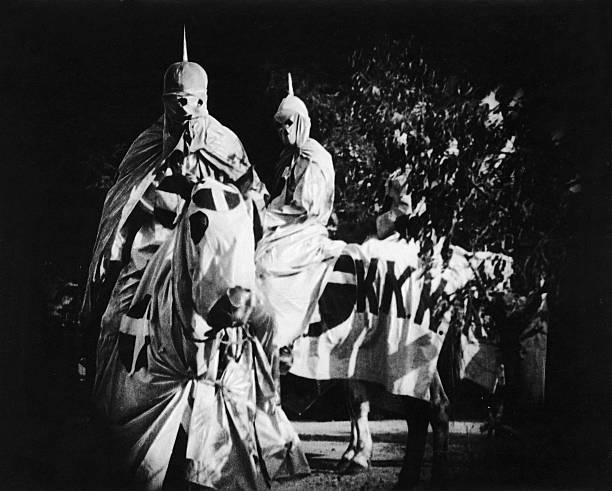
History of the Ku Klux Klan is generally agreed among Klan scholars that there are three distinct Klan Eras that have passed; how history will remember the current Era of the Klan is, of course, still open for debate. There are those who argue that the Klan has already moved into its Fifth Era, an event that may be not so nice, and they might well be right. Some prefer to linger in the “altruistic idealism” of the Fourth, for the good that might yet come of it. Likewise the dates, as explained below, given for the separate Eras are somewhat arbitrary.First Era (1865-1877): Grand Wizard Gen. Nathan Bedford Forrest.The Union Leagues and the Freedmen’s Bureau are being administered through the War Department. The Federal government is in the hands of radical revolutionists. The Ku Klux rise up against corrupt military governors and their Negro stooge-militia, and the Invisible Empire is born. In the several pitched battles that occur between the Ku Klux Klan and the occupation Negro-militia, the Klan nearly always comes off victorious. The puppet regimes respond by passing anti-Klan laws. There were also bogus Klans, some even directed by the Union League itself in order to commit crimes that would discredit the Klan. It was largely in response to these that Grand Wizard Forrest issued his famous disbandment order of 1869, commanding the Klansmen to destroy their regalia. By this time most of the carpetbaggers, scalawags and their Negro-stooges had been driven out of office in the South and order had been restored. The Ku Klux Klan remained active until 1873 in Mississippi and Alabama. In areas of South Carolina, Florida and Louisiana, where they were known as Knights of the White Camellia, the Ku Klux continued until the Compromise of 1877, which resulted in the passage of the Posse Comitatus and ended the last of the Reconstruction regimes. Once the Ku Klux of the First Era had achieved their objective of restoring unalienable rights and Constitutional law and order, they faithfully disbanded.Second Era (1915-1944): The Ku Klux Klan of the Second Era is an entirely different organization, revived by Imperial Wizard William Joseph Simmons, a Freemason of the Blue Lodge and also member of the Knights Templar, to become a Lodge dedicated to the advancement of white native Americans. The Urban League and the World Zionist Congress had already been formed some three and twenty years earlier. Contemporaneous events are the organization of the NAACP and the American Jewish Congress. The Klan is essentially a Post-World War I movement, and by 1919 (when the Prohibition Amendment is ratified) it numbers just over 100,000 members, with a strong base of support among Protestant-Christian Fundamentalists, who are also strong supporters of Prohibition. Meanwhile, Joseph Pulitzer (who had bought the New York World back in 1882 to sway the Populist Party) and William Randolph Hearst initiate a vicious media attack on the Klan, based upon rumor and allegations later proven to have been false. The smear campaign backfires, the ranks of the Invisible Empire begin to swell with new applicants, and soon reach 4,000,000 members.In 1920, the Klan, cleared by a congressional investigation, purchases Lanier University at Atlanta, and renames this The University of America. This institution is dedicated to the cultural advancement and enrichment of white native Americans. At this critical time, Dr. Hiram Wesley Evans, a Texas dentist, conspires with a number of Grand Dragons to stage a coup. Simmons agrees to step down, and accepts the honorary title of Emperor. Evans takes charge of the Klan in 1923. The Johnson-Reed Act is passed in 1924, curbing the heretofore-unrestricted inflow of immigrants into the USA, and this is largely a result of the efforts that had been made by the Ku Klux Klan and affiliated eugenics societies. In 1925, Hearst & Pulitzer seize upon the case of David Curtiss Stephenson, Grand Dragon of the Realm of Indiana, who is charged with the rape of Madge Oberholtzer, who later poisons herself and dies. Under incessant media attack for its moralistic attitudes, Klan membership plummets, so that by the time of the 21st Amendment (Repeal of Prohibition) in 1933, it is down to 100,000. Americans can feel safe to drink again. In 1944, the IRS levies a $640,000 lien against the Klan for back taxes, and Imperial Wizard James A. Colescott orders the second disbandment. The Ku Klux cease to exist as a national organization.Third Era (1946-1974): Dr. Sam Greene revives the Ku Klux at Stone Mountain, Georgia, and the Invisible Empire is reborn at the grassroots, having no national organization. Concurrent events are creation of the United Nations, the television media, and a radical government policy of forced integration under guise of the Civil Rights movement. Primary source material of this era is difficult to obtain, and media attention is focused on the radical fringe of the Ku Klux who, as noted, had been infiltrated by government moles and agents provocateur. Period issues of the Fiery Cross, published by the United Klans under Imperial Wizard Robert Shelton, reveal a remarkable insight into events of the time, which are culminating today in the birth of the New World Order. Many elements of the Unified Conspiracy Theory, which have been rediscovered by the “Patriot-Militia” movement of the 1990s, had been originally compiled during the Third Era by the Ku Klux Klan. The media and educational blitz of hate and misinformation against the Klan take their toll, frightening away the business, professional and academic class of white males, who should have been the Klan’s strongest supporters.Fourth Era (1974-1981): As forced desegregation programs give way to “Affirmative Action” and the advancement of minorities over whites, David Duke emerges from Louisiana to create a new and positive image for the Klan. He presents the argument of equal rights for whites, that the Ku Klux are an organization to promote the interests, ideals and culture of white native Americans. The media is livid, and does everything in its power to destroy this image of respectability, repeating its shibboleth that the Ku Klux are nothing but bigots and terrorists.Fifth Era (1981-PRES): Louis Beam organizes the Texas Emergency Reserve to stop the irredentism of Vietnamese fishermen into Galveston Bay, and later formulates his strategy of paramilitary leaderless resistance. Former Green Beret Glenn Miller organizes the White Patriot Party in North Carolina, and is prosecuted by Morris Dees in 1986 on bogus weapons charges, following a government “set-up and sting” operation. With the emergence of gun control under the Clinton Administration, the Christian-Patriot movement sweeps across America, as mostly-rural whites begin to realize that our nation has been betrayed. Although the Patriots deny any connection with the Klan, and go to great lengths to prove they are not “racist” (as though that really makes a difference), they are, in fact, a rebirth of the Ku Klux spirit. They just haven’t discovered the fact, yet.By the 1970s, it had become clear that post-WWII Communist revolution (led by Martin Luther King, Jews, academia and white apologists) had won the struggle over America’s future. The apparent split in the Klan between the “fourth” and “fifth” eras represents a divergence in opinion over strategic planning for the Resistance, and what will be the role and objectives assigned to the Klan. It is this author’s opinion that the confusion will be resolved over then next decade (2001-2010).Looking back over the past 135 years of the Klan, the crucial events had occurred early in the Second Era. It appears certain that Imperial Wizard W.J. Simmons had revived the Klan with the full blessing of Freemasonry. The Ku Klux Klan had played a vital role in securing passage of the 1917 Immigration Act, the 19th Amendment (Prohibition) and the 1924 Johnson-Reed Act, which stopped the huge influx of East Europeans (most of them Jews) and Mexicans who were overrunning this country. During this period the Klan controlled nearly 100 seats in Congress, more than a dozen state legislatures and governorships, and several hundred counties.But it was the purchase of Lanier University that marked the real high-water mark of the Klan, because it was here that a movement dedicated to the preservation of the white native American people – the sons of the Pioneers – was about to become an institution of higher learning, part of the Education Complex, and this would inevitably have lead to the academic validation of theorems such as those presented here in The Last Chuckle … Beyond Conspiracy!